The world students will enter tomorrow is changing rapidly.
Artificial intelligence, automation, robotics, biotechnology, space technology, renewable energy, advanced computing and other emerging fields are changing the way people work and solve problems. As technology continues to evolve, students will need more than the ability to memorise information and reproduce it in an examination.
They will need to know how to think, how to solve problems, how to adapt and how to learn continuously.
This is where Science, Technology, Engineering and Mathematics (STEM) education becomes increasingly important.
STEM education is not simply about preparing students for technical careers. It can help students develop a combination of knowledge and skills that are useful for understanding the world and solving real-world problems.
So, what skills will students need for the future?
What Is STEM Education?
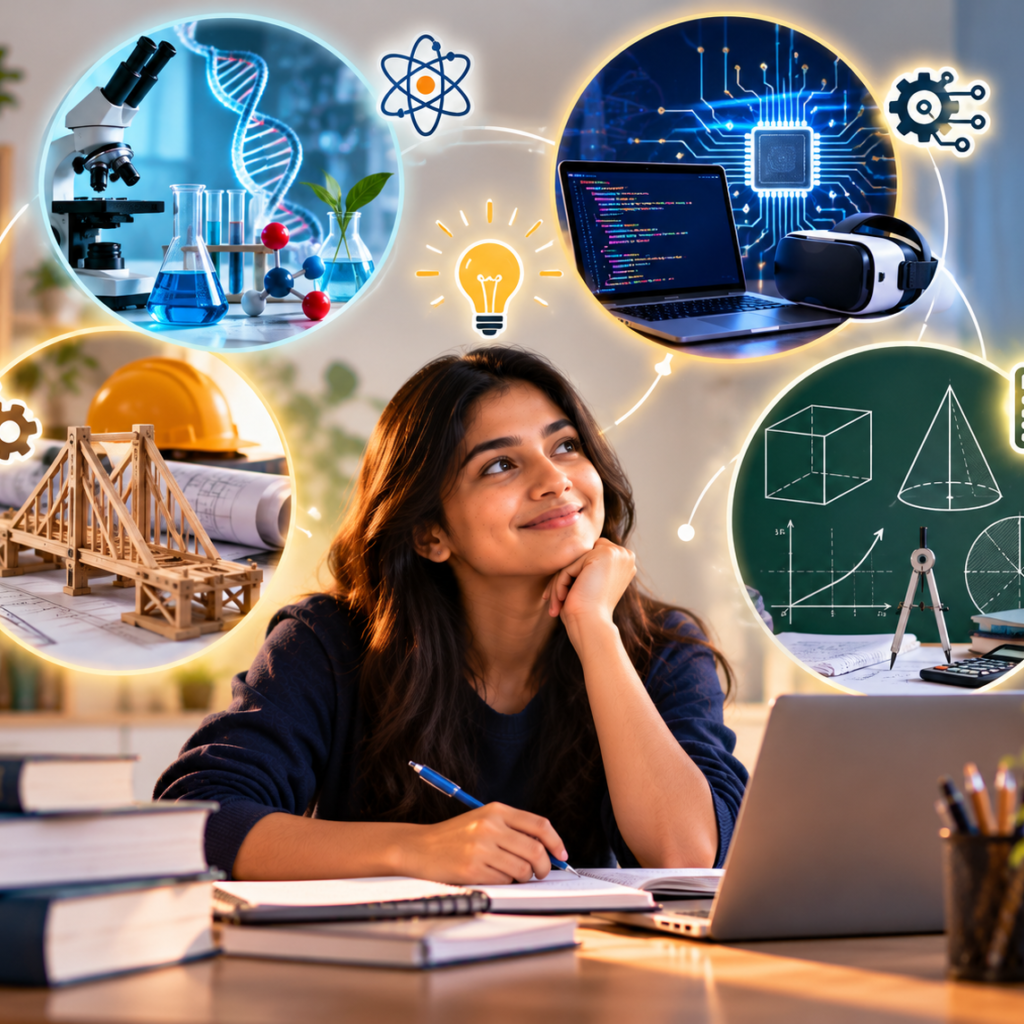
STEM stands for:
- S – Science
- T – Technology
- E – Engineering
- M – Mathematics
Although these are four different areas, STEM learning encourages students to see how they connect.
For example, designing a water-saving system could involve:
- Science to understand water and environmental processes
- Technology to develop or operate a solution
- Engineering to design and improve the system
- Mathematics to measure, calculate and analyse results
The objective is not simply to study these subjects separately but to learn how knowledge from different areas can be used to solve problems.
Why Will STEM Skills Matter in the Future?
Students today are growing up in an environment where information is readily available.
A student can search for an explanation, watch a demonstration or use an AI tool within seconds.
This changes an important question:
If information is easily available, what should students actually learn?
The answer is not that factual knowledge is no longer important. Strong foundational knowledge remains essential.
However, students also need the ability to use knowledge effectively.
Knowing a physics principle is useful.
Being able to apply that principle to a new problem is even more useful.
Knowing a mathematical formula is useful.
Understanding when and why to use it is a deeper skill.
This is why future-ready education needs to combine knowledge with thinking and application.
1. Scientific Thinking
One of the most important future skills is the ability to think scientifically.
Scientific thinking involves:
- Asking questions
- Observing carefully
- Making predictions
- Forming explanations
- Testing ideas
- Analysing evidence
- Drawing conclusions
- Changing conclusions when evidence demands it
Students who develop these habits don’t simply accept information because someone told them it is true.
They learn to ask:
“How do we know?”
This is valuable in science classrooms, laboratories, workplaces and everyday life.
2. Problem-Solving Skills
Future challenges will rarely arrive as straightforward textbook questions.
Students may encounter problems that don’t have an immediately obvious solution.
Problem-solving requires students to:
- Understand the problem
- Identify relevant information
- Break the problem into smaller parts
- Generate possible approaches
- Test solutions
- Learn from unsuccessful attempts
- Improve their approach
This is one reason problem-based and project-based STEM activities can be powerful learning experiences.
The goal is not always to find an answer immediately.
Sometimes the goal is to develop a better way of approaching the problem.
3. Critical Thinking
Students are exposed to enormous amounts of information every day.
- Some information is accurate.
- Some is incomplete.
- Some is misleading.
Students therefore need to learn how to evaluate information rather than automatically accept it.
Critical thinking involves asking:
- What is the evidence?
- Is the source reliable?
- Is there another explanation?
- What assumptions are being made?
- Is the conclusion supported by the evidence?
- What information might be missing?
These questions help students become more independent learners.
4. Creativity and Innovation
STEM is not only about finding the correct answer.
It is also about finding new ways to approach problems.
A student designing a bridge, robot, water filter or energy-saving solution may have several possible designs.
Creativity helps generate possibilities.
Science and mathematics help evaluate them.
Engineering helps turn ideas into workable solutions.
This combination of creativity and analytical thinking is an important part of innovation.
5. Ability to Experiment and Learn From Failure
Real-world innovation rarely happens perfectly on the first attempt.
A design may not work.
An experiment may produce an unexpected result.
A proposed solution may need modification.
Students should therefore understand that an unsuccessful attempt can provide useful information.
A powerful learning cycle is:
Design → Build → Test → Analyse → Improve
This teaches students to treat mistakes as opportunities to learn rather than reasons to stop.
6. Mathematical Thinking
Mathematics will remain an important foundation for STEM learning.
But mathematical thinking goes beyond performing calculations.
Students need to develop the ability to:
- Recognise patterns
- Estimate
- Compare quantities
- Interpret data
- Identify relationships
- Use logical reasoning
- Build mathematical models
- Apply mathematics to real situations
For example, understanding percentages becomes more meaningful when students use them to analyse real data rather than only solve textbook exercises.
7. Digital and Technological Literacy
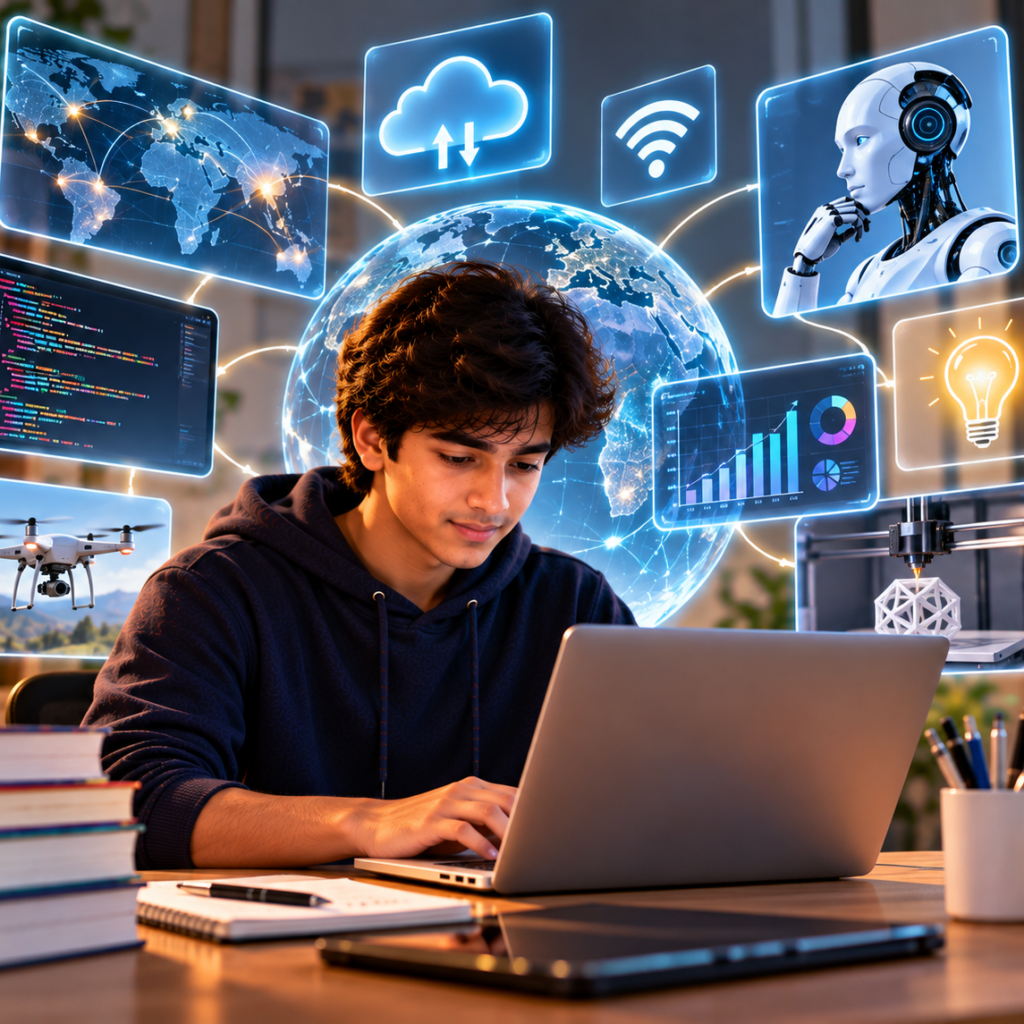
Technology is becoming part of almost every field.
Students don’t necessarily need to become programmers or technology specialists, but they should understand how technology works and how to use digital tools responsibly.
Digital literacy can include:
- Understanding basic computing concepts
- Working with digital information
- Using appropriate digital tools
- Understanding data
- Evaluating online information
- Understanding basic principles of AI
- Using technology ethically and responsibly
The goal should be to help students become users and creators of technology, rather than passive consumers.
8. AI Literacy
Artificial intelligence is becoming increasingly relevant to education and professional life.
Students will need to understand not only how to use AI tools but also their limitations.
AI literacy can involve understanding:
- What AI systems can and cannot do
- Why AI-generated information needs verification
- How to ask effective questions
- How to evaluate AI-generated answers
- Issues related to bias, privacy and responsible use
Students should learn that an AI-generated answer is not automatically a correct answer.
The ability to question, verify and reason remains essential.
9. Communication Skills
Being able to solve a problem is only part of the process.
Students also need to communicate their ideas.
STEM communication can involve:
- Explaining a concept clearly
- Presenting a project
- Writing observations
- Interpreting graphs
- Discussing results
- Defending a conclusion using evidence
A student who can both think clearly and communicate clearly can make their ideas much more useful to others.
10. Collaboration
Many real-world scientific and technological developments are team efforts.
Students can develop collaboration skills through group projects, experiments and design challenges.
They learn to:
- Listen to different ideas
- Divide responsibilities
- Discuss disagreements
- Give constructive feedback
- Combine different approaches
- Work towards a shared goal
Collaboration doesn’t mean everyone has to think alike.
Good collaboration often involves bringing different ideas together.
11. Adaptability and Lifelong Learning
Perhaps one of the most important future skills is the ability to keep learning.
Technology will continue to change.
Some tools and technologies that are common today may become less important tomorrow, while new ones will emerge.
Students therefore need to become comfortable with learning unfamiliar concepts.
Instead of asking:
“Will I ever need this?”
students can develop a more useful mindset:
“How can I learn something new when I need it?”
This is the foundation of lifelong learning.
12. Curiosity
Before scientific discovery comes a question.
Why does this happen?
What would happen if we changed this?
Can we make it better?
Is there another explanation?
Curiosity encourages students to investigate rather than simply accept.
A classroom where students are encouraged to ask questions can therefore become a place where scientific thinking develops naturally.
How Can Schools Develop These Future Skills?
Future-ready education doesn’t necessarily require complicated technology or expensive equipment.
Teachers can introduce these skills through simple activities.
For example:
Instead of only asking:
“What is the answer?”
Ask:
“How did you arrive at your answer?”
Instead of:
“Follow these instructions.”
Try:
“Can you find another way to solve this problem?”
Instead of:
“Your experiment didn’t work.”
Ask:
“What did the result tell you?”
Instead of:
“Memorise this definition.”
Ask:
“Can you explain this concept in your own words?”
These small changes can transform learning from passive information collection into active exploration.
How Igniters Supports This Approach
Developing future-ready skills requires more than completing a syllabus. Students need opportunities to understand concepts, ask questions, solve problems and receive guidance while they learn.
This is where a personalised approach to science education can make a difference.
At Igniters, learning is designed around conceptual understanding, individual attention and mentorship rather than treating every student exactly the same. Through discussions, problem-solving, practical learning and academic guidance, students are encouraged to understand why something works rather than simply memorising what to write.
For students preparing for school examinations as well as competitive pathways such as JEE, NEET, Olympiads and other science-focused examinations, strong fundamentals and problem-solving habits can provide a useful foundation.
The larger objective is to help students become independent learners who can think, question and apply what they learn.
This approach aligns naturally with the skills that STEM education seeks to develop: curiosity, reasoning, experimentation, problem-solving and continuous improvement.
The Future Belongs to Learners, Not Just Knowledge Collectors
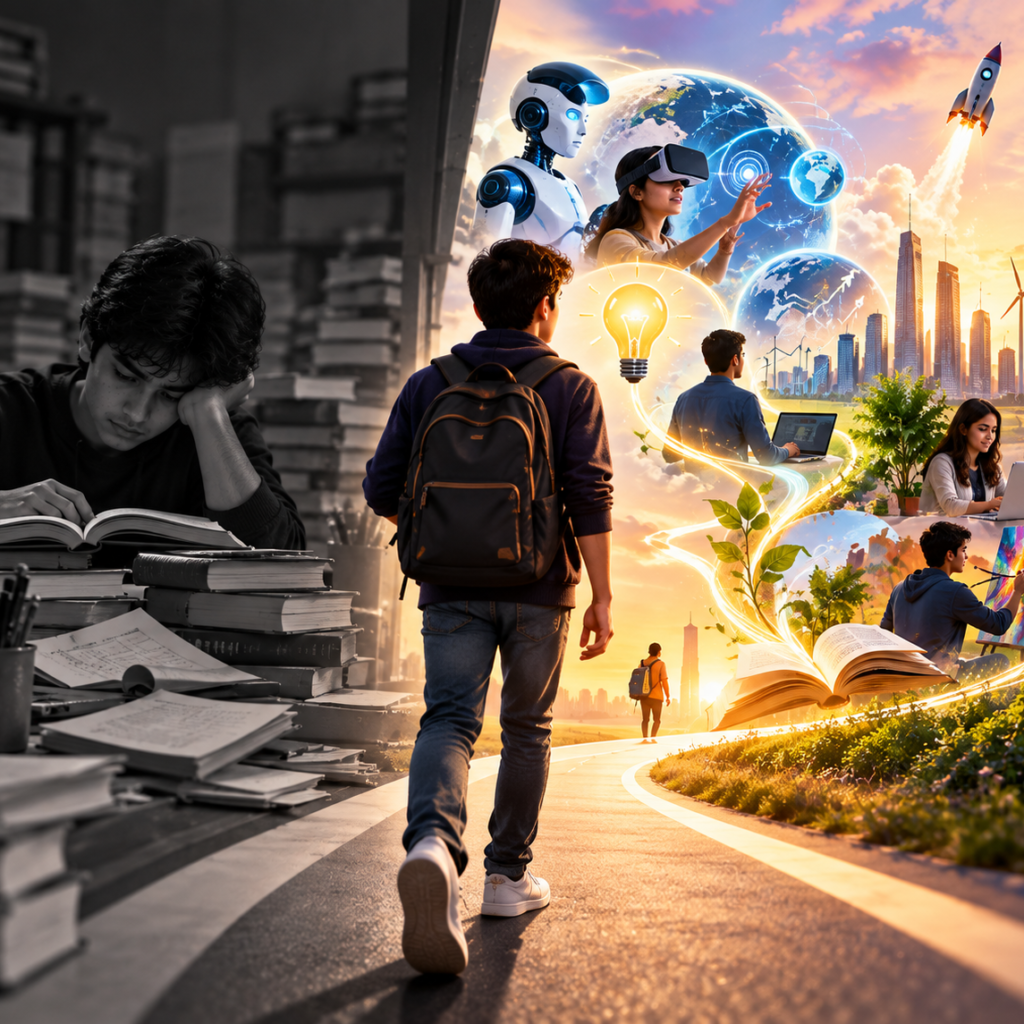
The future of education is not about choosing between traditional knowledge and modern skills.
Students need both.
They need strong foundations in:
Science + Mathematics + Technology + Concepts
And they also need:
Curiosity + Critical Thinking + Creativity + Problem-Solving + Communication + Adaptability
Knowledge provides the foundation.
Skills help students use that knowledge.
Curiosity encourages them to explore further.
And the ability to learn continuously helps them adapt when the world changes.
Final Takeaway
Preparing children for the future does not mean trying to predict exactly which jobs they will have.
Instead, we can help them develop the ability to learn, think, question, create and solve problems.
STEM education provides a natural environment for developing these abilities.
The future may bring technologies that today’s students cannot yet imagine. But students who learn how to ask good questions, understand concepts, evaluate evidence, experiment, collaborate and improve their ideas will be better prepared to learn whatever comes next.
Don’t just prepare students for the jobs of the future. Prepare them to become lifelong learners who can understand and shape that future.
Igniters Science Club, an initiative of Igniters for Tomorrow, aims to encourage this mindset by making science more conceptual, curious, practical and connected to real-world problem-solving.
Leave a Reply