
Have you ever noticed how children ask questions about things adults often ignore?
- Why does a shadow change its position?
- Why do some leaves have different shapes?
- Why does ice melt when we take it out of the freezer?
- Why does the Moon look different on different nights?
These questions often begin with something simple: observation.
Observation is one of the most fundamental skills in scientific learning. Before scientists develop explanations, conduct experiments, or discover new things, they observe what is happening around them.
Children can develop this skill, too. They do not need an expensive laboratory or complicated scientific equipment. Everyday objects, natural surroundings, and simple activities can help them learn to notice details, recognise patterns, ask questions, and think scientifically.
So, how can parents and teachers develop observation skills in children?
Let’s explore why observation matters and discover practical activities that make learning science more meaningful.
What Are Observation Skills?
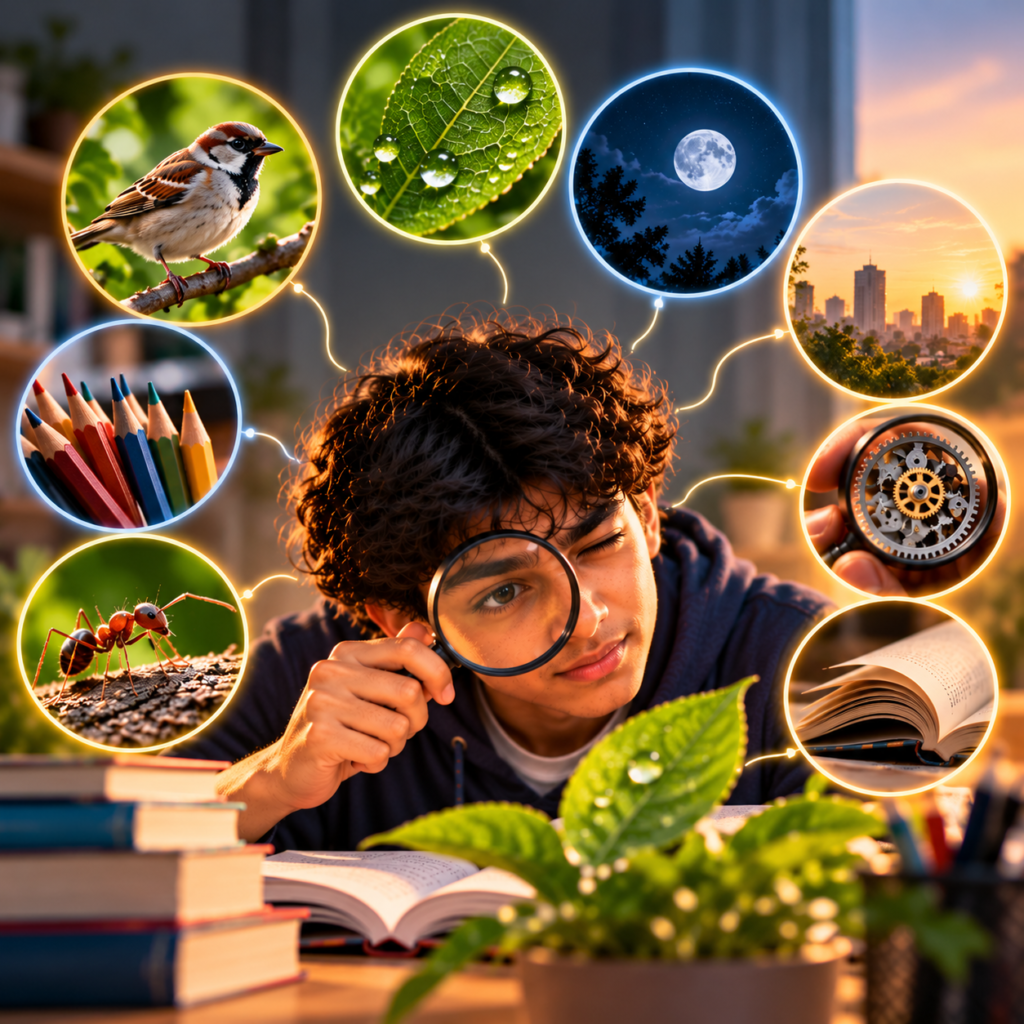
Observation skills are the ability to notice, examine, and describe details about objects, events, patterns, and changes in our surroundings.
Observation can involve several senses, including sight, hearing, and touch when it is safe and appropriate. Scientific observation also involves using instruments such as rulers, thermometers, magnifying glasses, and measuring containers.
For example, a child might observe a plant and notice that:
- Its leaves are different sizes.
- Some leaves are darker than others.
- New leaves appear at the tips of certain branches.
- The soil looks different after watering.
- The plant changes as it grows.
These observations can lead to questions about plant growth, water, sunlight, and living organisms.
Observation is not simply looking at something. It is paying attention to what is happening and identifying details that might otherwise go unnoticed.
Why Are Observation Skills Important in Science?
Observation provides the foundation for several other scientific skills.
1. Observation Encourages Curiosity
Children become curious when they notice something unusual or unexpected.
A child who observes that a wet patch on the floor gradually disappears may ask where the water went.
That question creates an opportunity to explore evaporation.
Similarly, observing that a shadow changes throughout the day can lead to questions about the Sun’s apparent movement and the formation of shadows.
When children learn to observe carefully, ordinary experiences can become opportunities for scientific exploration.
2. Observation Develops Critical Thinking
Suppose a student notices that one plant is taller than another.
The student might immediately conclude that the taller plant received more sunlight.
But is that necessarily true?
Perhaps the plants are different species. Maybe one received more water, or the soil conditions were different.
Careful observation encourages children to distinguish between what they actually observe and what they think might explain it.
This distinction is an important part of critical thinking.
3. Observation Improves Scientific Problem-Solving

When students encounter an unfamiliar problem, they need to identify the information that matters.
In science, this might mean examining a diagram, reading a graph, noticing a pattern in experimental results, or identifying which conditions changed.
Students who develop observation skills may become better equipped to recognise relevant details instead of jumping to conclusions.
4. Observation Supports Better Learning
Many science concepts become easier to understand when students can connect them to something they have observed.
For example, a student who watches ice melt can connect the experience to changes of state.
A student who observes how a shadow changes can develop a more concrete understanding of light and shadow.
These experiences do not replace formal scientific explanations. Instead, they give students something meaningful to connect those explanations to.
8 Simple Activities to Develop Observation Skills in Children
The following activities can be conducted at home, in a classroom, or during supervised outdoor learning.
Activity 1: Become a Nature Detective
Ask children to observe a plant, tree, flower, or small outdoor area for five minutes.
Instead of simply asking them to name what they see, encourage them to record five specific observations.
For example:
- The leaf has a pointed tip.
- The stem has a lighter colour near the top.
- Two leaves have small holes.
- The soil is darker near the base.
- A small insect is moving across the surface of a leaf.
Then ask children to separate observations from explanations.
“The leaf has holes” is an observation.
“Insects may have eaten the leaf” is a possible explanation that needs further evidence.
What children learn: Attention to detail, descriptive skills, and evidence-based reasoning.
Activity 2: Observe a Shadow
Place a stationary object in a safe outdoor location where sunlight creates a visible shadow.
Ask children to observe the shadow at different times of the day, such as morning and afternoon.
They can record:
- The shadow’s direction
- Its approximate length
- How its position changes
- Whether cloud cover affects visibility
Ask them to predict what might happen before the next observation.
Later, discuss how the apparent position of the Sun in the sky affects the direction and length of shadows.
What children learn: Prediction, measurement, patterns, and the relationship between observations and scientific explanations.
Activity 3: Explore Melting Ice
Place an ice cube in a suitable container and let children observe it as it melts.
Ask them to record what changes and what stays the same.
They might notice that:
- The solid ice becomes liquid water.
- The shape changes continuously.
- Water collects at the bottom of the container.
- The process takes time.
Encourage them to describe the changes before introducing the scientific explanation.
What children learn: Changes of state, careful observation, and recording changes over time.
Activity 4: Compare Leaves
Collect a few fallen leaves of different shapes and sizes.
Ask children to compare them.
They can examine:
- Shape
- Colour
- Size
- Vein patterns
- Surface texture, using gentle observation
Ask them to group the leaves according to similarities and differences.
There may be several reasonable ways to classify them, depending on the characteristics selected.
What children learn: Classification, comparison, pattern recognition, and biological observation.
Activity 5: The Observation Tray
Place five to eight familiar, safe objects on a tray. For example, use a pencil, paper clip, leaf, spoon, eraser, and paper cup.
Give children one minute to observe the objects.
Then cover the tray and ask them to write down as many details as they can remember.
For an advanced version, let them observe the tray again and identify details they missed the first time.
Explain that the objective is not simply to remember objects but to notice their characteristics.
What children learn: Attention, visual observation, description, and memory.
Activity 6: Track the Weather
Ask children to record daily weather observations for one week.
They can note:
- Cloud cover
- Whether it is sunny or rainy
- Approximate temperature, if a thermometer is available
- Wind conditions, observed safely
- Changes in the sky
At the end of the week, ask them to identify patterns.
Was every day similar? Did the weather change gradually or suddenly?
Remind them that a week of observations is not enough to establish a long-term climate pattern.
What children learn: Data recording, comparison, pattern recognition, and the difference between weather and climate.
Activity 7: Listen Like a Scientist
Observation is not limited to sight.
Ask children to sit quietly in a safe place and identify different sounds.
They might hear birds, vehicles, footsteps, fans, or wind moving through leaves.
Ask them to describe each sound without immediately identifying its source.
For example:
“The sound is high-pitched and repeats at regular intervals.”
Then ask what might be producing it and what evidence could help them check.
What children learn: Attention, careful description, and distinguishing observations from interpretations.
Activity 8: Predict, Observe, Explain
Choose a simple, safe activity, such as placing an ice cube on a plate.
Ask children three questions:
- Predict: What do you think will happen?
- Observe: What actually happens?
- Explain: Why do you think it happened?
Their prediction does not have to be correct.
The important part is comparing the prediction with the result and discussing possible explanations.
This approach helps children understand that scientific ideas can be examined against observations.
What children learn: Prediction, evidence-based thinking, and scientific reasoning.
Observation vs Inference: An Important Difference
One of the most useful lessons children can learn is the difference between an observation and an inference.
An observation describes what has been noticed or measured.
An inference is a possible explanation based on available evidence.
Consider this example:
A student sees dark clouds in the sky.
- Observation: Dark clouds are visible.
- Inference: Rain may occur soon.
The observation describes what the student sees. The inference uses that observation to suggest what might happen.
However, dark clouds do not guarantee rainfall.
Teaching children this distinction helps them understand why scientists need evidence before accepting explanations.
How Parents and Teachers Can Encourage Better Observation
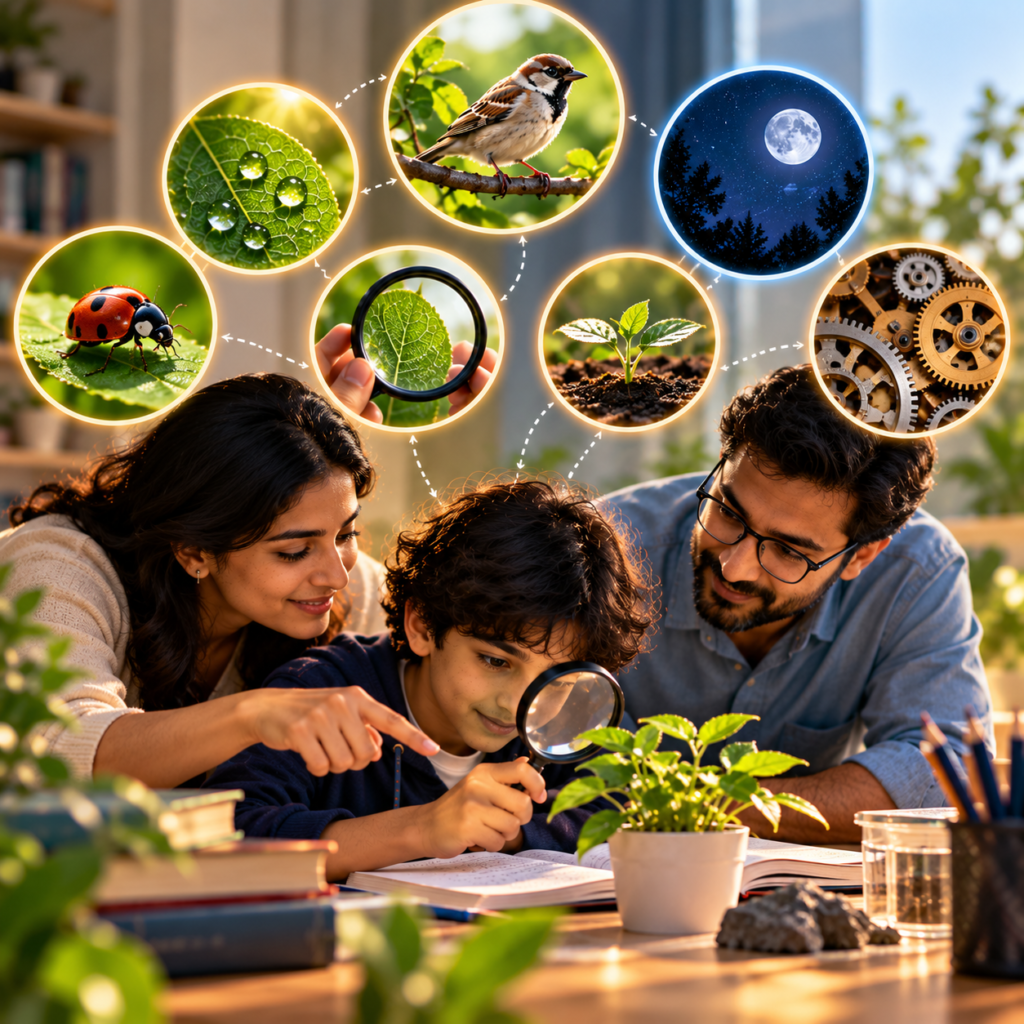
Children develop observation skills through regular practice. Adults can support this process by making small changes to everyday conversations.
Ask Open-Ended Questions
Instead of asking only, “What is this?”, try:
- What do you notice?
- What is different?
- What has changed?
- What surprised you?
- What would you like to investigate?
These questions encourage children to examine details instead of searching only for a predetermined answer.
Give Children Time
Observation takes patience.
Avoid immediately explaining everything a child notices. Allow them time to examine an object, describe what they see, and develop their own questions.
Encourage Drawing and Recording
Children can maintain a simple observation journal containing drawings, measurements, descriptions, and questions.
Over time, they can compare entries and notice changes that are difficult to identify from memory alone.
Avoid Treating Every Mistake as a Failure
A child may make an incorrect prediction or suggest an explanation that does not fit the evidence.
Use the opportunity to ask what additional information might help.
The purpose is to develop reasoning, not to expect children to know every answer immediately.
How Igniters Encourages Scientific Thinking
At Igniters Science Club, an initiative of Igniters for Tomorrow, the broader aim is to encourage students to develop curiosity and understand science beyond memorised definitions and formulas.
Observation is an important part of this approach.
When students are encouraged to ask questions, examine patterns, connect concepts with everyday experiences, and explain their reasoning, science becomes more than a subject to study for examinations.
A personalised learning environment can also help students work through misunderstandings and develop confidence in their own thinking.
Whether a student is exploring basic science concepts, strengthening school-level understanding, or preparing for science-focused competitive examinations, the habit of observing carefully and asking meaningful questions can support deeper learning.
Final Thoughts: Teach Children to Notice Before You Teach Them to Explain
Scientific discovery often begins with noticing something that other people have overlooked.
A changing shadow, a growing plant, a melting ice cube, or an unusual pattern can become the starting point of a valuable learning experience.
Parents and teachers do not need complicated equipment to encourage this habit.
They can begin by asking children to slow down, pay attention, record what they notice, and investigate their questions.
The most important lesson is simple:
Observe carefully. Ask questions. Look for evidence. Then develop an explanation.
By making observation a regular part of learning, we can help children become more curious, thoughtful, and independent learners.
Igniters Science Club, an initiative of Igniters for Tomorrow, encourages this spirit of scientific exploration—helping young learners move beyond memorisation towards understanding, questioning, and discovering how the world works.
Leave a Reply