
Have you ever been asked a question that didn’t have just one correct answer? Or solved a puzzle by thinking differently? If yes, you’ve already used critical thinking.
Critical thinking is one of the most important skills students can develop. It helps you analyse information, solve problems, make smart decisions, and understand the world beyond textbooks. In today’s world, where information is everywhere, learning how to think is far more valuable than simply memorising facts.
At Igniters Science Club, an initiative of Igniters for Tomorrow, we encourage students to develop curiosity, creativity, and critical thinking through hands-on learning and scientific exploration.
Let’s explore some fun and effective activities that can help you become a better thinker.
What Is Critical Thinking?
Critical thinking is the ability to carefully observe, ask questions, evaluate evidence, and make logical decisions instead of jumping to conclusions.
A critical thinker doesn’t just ask “What?” They also ask:
- Why?
- How?
- What if?
- Is there another way?
- What evidence supports this?
The best part? Critical thinking can be developed with regular practice.
1. Solve Brain Teasers and Logic Puzzles
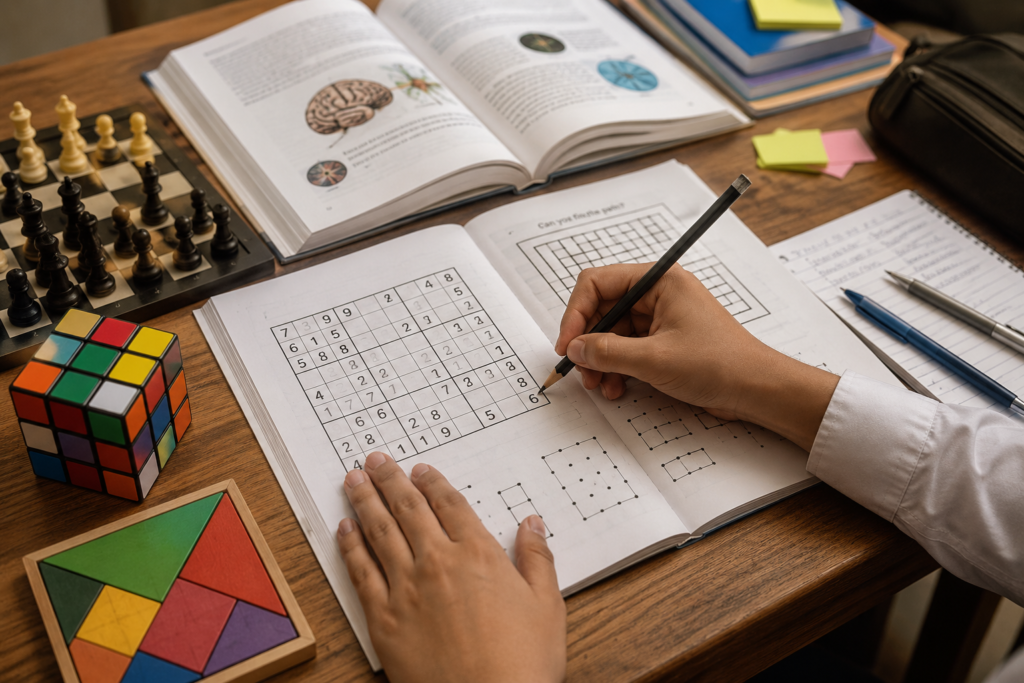
Brain teasers challenge your mind to think beyond the obvious. Sudoku, riddles, crossword puzzles, and logic games improve reasoning, concentration, and problem-solving skills.
Challenge: Solve one puzzle every day and try explaining your solution to someone else.
2. Ask “Why?” Five Times
This simple activity helps you understand the root cause of any problem.
For example:
Problem: Plants are drying.
- Why? → They aren’t getting enough water.
- Why? → Nobody watered them.
- Why? → The watering schedule wasn’t followed.
- Why? → There wasn’t a reminder.
- Why? → We never planned one.
By asking “Why?” repeatedly, you move beyond the surface and discover the real issue.
3. Predict Before You Experiment
Before performing a science experiment, make a prediction.
Ask yourself:
- What do I think will happen?
- Why do I think so?
After the experiment, compare your prediction with the actual result. Even if you’re wrong, you’ve learned something valuable.
4. Observe the World Around You
Great thinkers notice details that others often miss.
Spend 10 minutes observing:
- Birds in a park
- Clouds in the sky
- Ants carrying food
- Traffic at a busy crossing
Write down patterns you notice and think about why they happen.
Observation is the foundation of scientific thinking.
5. Play “What If?”

Imagine different possibilities.
For example:
- What if gravity suddenly disappeared?
- What if plants could walk?
- What if humans could breathe underwater?
There may not be one correct answer, but thinking through different possibilities strengthens creativity and logical reasoning.
6. Spot the Fake Information
Not everything you read online is true.
Choose an interesting science fact and ask:
- Who shared this information?
- Is there scientific evidence?
- Can I find another reliable source?
Learning to verify information is an essential critical thinking skill in today’s digital world.
7. Build Something
Create a bridge using paper, design a tower with ice cream sticks, or build a simple model from recycled materials.
While building, think about:
- Why did it collapse?
- How can I make it stronger?
- What should I improve?
Every challenge teaches you to analyse, test, and improve your ideas.
8. Discuss Different Opinions
Choose a simple topic like:
“Should homework be given every day?”
Listen to both sides before deciding what you think.
Critical thinking isn’t about proving you’re right—it’s about understanding different perspectives and supporting your ideas with reasons.
9. Keep a Curiosity Journal

Carry a notebook and write down questions that come to your mind.
Examples:
- Why is the moon visible during the day?
- Why do leaves change colour?
- How do birds know where to migrate?
Try finding answers through books, experiments, or trusted educational resources.
The more questions you ask, the stronger your thinking becomes.
10. Learn from Mistakes
Many students fear making mistakes, but every mistake is an opportunity to improve.
Instead of saying,
“I got it wrong.”
Ask yourself,
- Why was my answer incorrect?
- What can I learn from it?
- How will I solve it differently next time?
Great thinkers grow by reflecting on their mistakes rather than avoiding them.
Why Critical Thinking Matters
Critical thinking isn’t just useful in science class. It helps students:
- Solve problems confidently
- Make better decisions
- Improve creativity
- Understand concepts more deeply
- Avoid believing false information
- Perform better in academics and competitive exams
- Become independent learners
These skills are valuable throughout school, college, and future careers.
A Quick Thinking Challenge
Look at a common object near you—a pencil, a spoon, or a water bottle.
Now answer these questions:
- Why was it designed this way?
- Could it be improved?
- Can it have another use?
- What problem does it solve?
This simple exercise trains your brain to observe, question, and think creatively.
Final Thoughts
Critical thinking is not a talent that only a few people are born with—it’s a skill that anyone can develop through curiosity, practice, and observation.
Every puzzle you solve, every question you ask, and every experiment you perform strengthens your ability to think independently.
At Igniters Science Club, an initiative of Igniters for Tomorrow, we believe education should inspire students to question, explore, and discover rather than simply memorise answers. Through engaging activities and inquiry-based learning, we help young minds build the confidence to think critically and solve real-world problems.
Remember, asking the right question is often the first step towards finding an extraordinary answer.
Leave a Reply