

Why does a bridge stand without falling? How does a smartphone work? How can a robot recognise an object? Why does a rocket move upward?
Questions like these connect different areas of learning—and that is exactly where STEM education comes in.
STEM stands for Science, Technology, Engineering, and Mathematics. But STEM learning is more than studying these four subjects separately. It is about bringing them together to understand problems, design solutions, experiment with ideas, and apply knowledge to real life.
At Igniters Science Club, an initiative of Igniters for Tomorrow, we believe that students learn best when they are encouraged to question, explore, create, and solve problems rather than simply memorise information.
Let’s understand what STEM learning really means and why it matters.
What Does STEM Stand For?
S — Science
Science helps students understand the natural world.
Students explore questions such as:
- Why does rain happen?
- How do plants grow?
- Why do objects fall?
- How does the human body work?
Science encourages observation, questioning, experimentation, and evidence-based thinking.
T — Technology
Technology involves using tools, systems, and knowledge to solve problems.
It isn’t limited to smartphones and computers. Even a simple calculator, water filter, or machine is technology.
E — Engineering
Engineering is about designing and building solutions.
Engineers ask:
“What problem can I solve, and how can I build something that works?”
Students can experience engineering by designing bridges, towers, machines, models, or simple devices.
M — Mathematics
Mathematics provides the language and tools needed to measure, calculate, analyse patterns, and make predictions.
From measuring the height of a tower to calculating the speed of a vehicle, mathematics is everywhere in STEM.
What Is STEM Learning?
STEM learning combines these four areas to solve problems and understand real-world situations.
Imagine students are given a challenge:
“Design a bridge that can hold as much weight as possible using only paper.”
They might:
- Use Science to understand forces.
- Use Mathematics to measure and compare designs.
- Use Engineering to build and improve the bridge.
- Use Technology to research designs or record results.
This is STEM learning in action.
Instead of simply reading about bridges, students think, build, test, and improve.
How Is STEM Different From Traditional Learning?
Traditional learning can sometimes focus heavily on remembering information.
STEM learning focuses more on using information.
For example, instead of only learning about electricity from a textbook, students might build a simple low-voltage circuit and investigate:
“What happens when the circuit is opened?”
Instead of memorising formulas about motion, they might measure how far a toy car travels and analyse the results.
The goal isn’t to replace textbooks. It is to make knowledge meaningful and applicable.
Why Is STEM Learning Important?
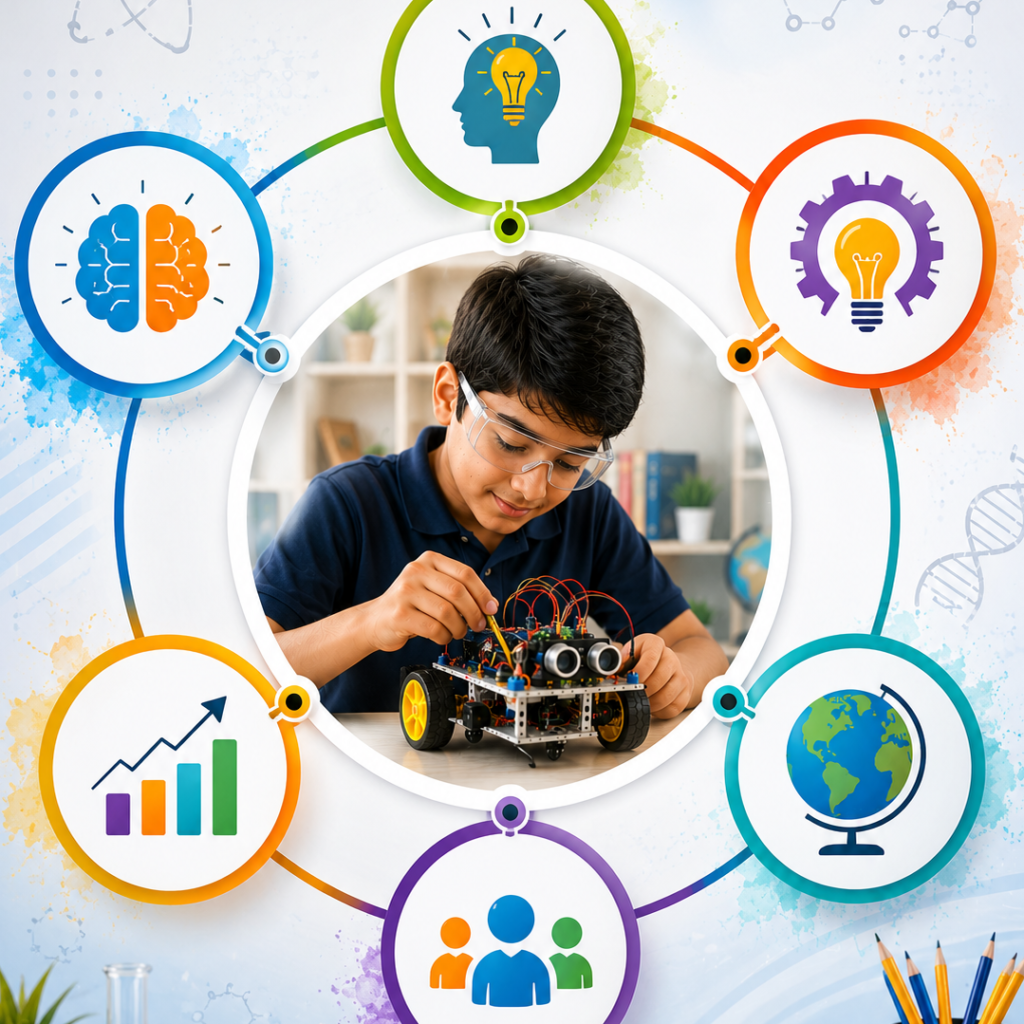
1. It Develops Problem-Solving Skills
Real-world problems rarely come with instructions.
STEM activities teach students to identify a problem, consider possible solutions, test their ideas, and improve them.
This develops a mindset that can be applied far beyond the classroom.
2. It Encourages Critical Thinking
STEM students learn to ask:
- What is the evidence?
- Why did this happen?
- Is there another solution?
- What can I change?
- How can I test my idea?
These questions develop critical thinking and logical reasoning.
3. It Makes Learning More Engaging
Imagine learning about forces by reading a definition versus designing a paper airplane and testing how far it flies.
When students actively participate, abstract concepts can become easier to understand and remember.
STEM turns learning into an experience.
4. It Encourages Creativity
STEM isn’t only about finding the correct answer.
Sometimes students need to create their own solution.
Two students may solve the same problem using completely different designs. This encourages creativity, experimentation, and flexible thinking.
5. It Teaches Students to Learn From Failure
A bridge collapses.
A robot doesn’t move.
An experiment produces an unexpected result.
What happens next?
STEM encourages students to ask:
“What went wrong, and how can I improve it?”
This teaches an important lesson: failure can provide useful information.
6. It Connects Learning With the Real World
STEM helps students see why their classroom learning matters.
Mathematics is used in architecture.
Physics is used in engineering.
Chemistry is used in medicine and materials science.
Biology is used in healthcare and biotechnology.
Technology connects almost every modern field.
STEM helps students recognise these connections early.
Simple STEM Activities Students Can Try
STEM learning doesn’t require an expensive laboratory.
Students can:
- Build a paper bridge.
- Design a paper airplane.
- Create a marble maze.
- Build a simple low-voltage circuit.
- Measure how quickly different objects roll.
- Design a water-saving model.
- Create structures using recyclable materials.
- Observe and record plant growth.
The important part isn’t the material.
It’s the thinking process.
A Simple STEM Learning Cycle
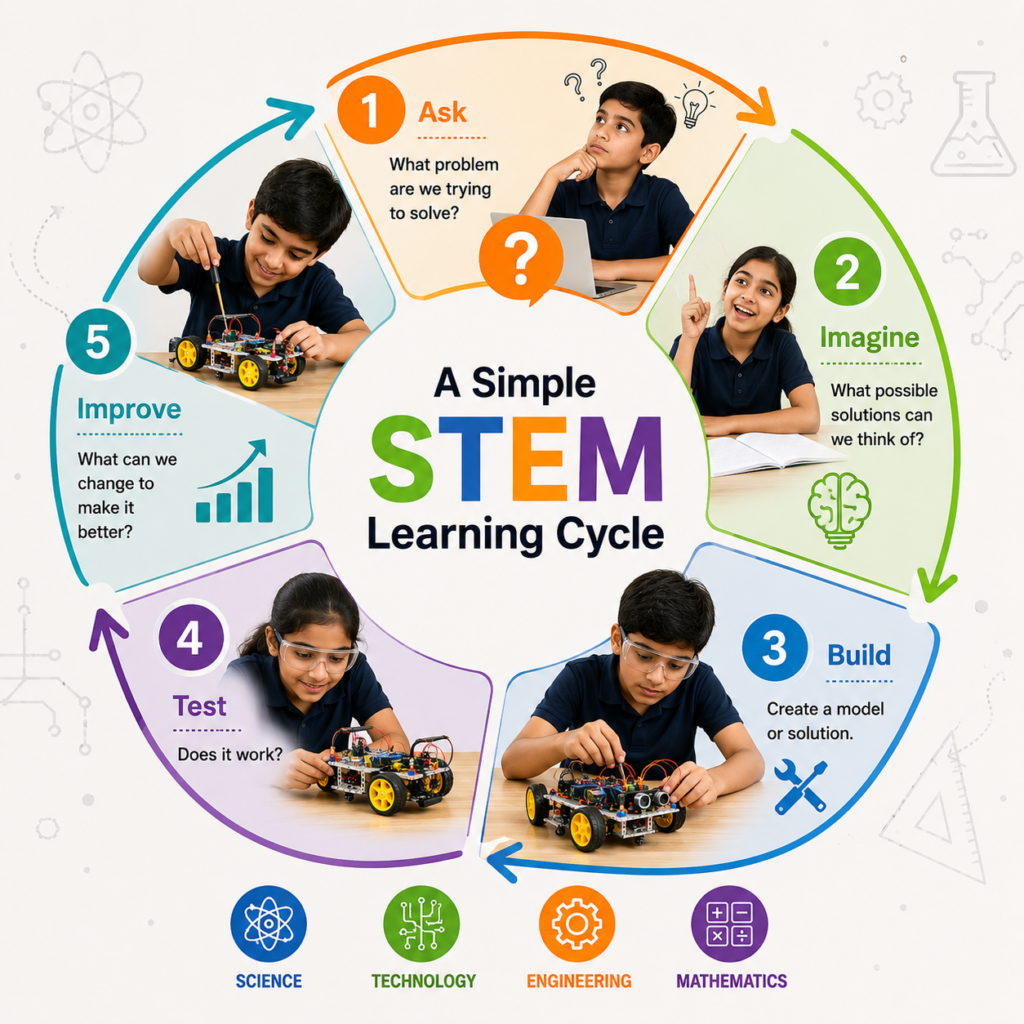
Students can follow this five-step process for almost any STEM challenge:
1. Ask
What problem are we trying to solve?
2. Imagine
What possible solutions can we think of?
3. Build
Create a model or solution.
4. Test
Does it work?
5. Improve
What can we change to make it better?
This process develops the habit of learning through experimentation and reflection.
Is STEM Only for Future Engineers and Scientists?
No.
STEM skills are useful regardless of the career a student eventually chooses.
A doctor needs problem-solving skills.
An entrepreneur needs analytical thinking.
A designer needs creativity.
A researcher needs curiosity.
A teacher needs communication and reasoning.
STEM learning develops transferable skills that can benefit students across many fields.
How Parents Can Encourage STEM Learning
Parents don’t need to be science experts to encourage STEM thinking.
At home, ask questions such as:
“Why do you think that happened?”
“What could we change?”
“How could we test it?”
“Can you design a better solution?”
Encourage children to experiment, build things, observe nature, solve puzzles, and discuss their ideas.
Most importantly, allow them to make mistakes and try again.
Final Thoughts
STEM learning is not simply about Science, Technology, Engineering, and Mathematics.
It is about developing a way of thinking.
It teaches students to ask questions, investigate problems, use evidence, create solutions, and continuously improve their ideas.
At Igniters Science Club, an initiative of Igniters for Tomorrow, we encourage young learners to experience science beyond textbooks through curiosity, hands-on activities, experimentation, and problem-solving.
Because the future doesn’t just need students who can remember information.
It needs young people who can question, understand, create, and solve.
And STEM learning helps build exactly those skills.
Leave a Reply